
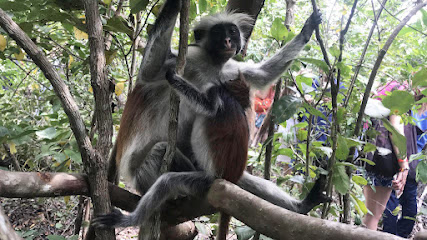
The Spirit of the Wild
Jozani Chwaka Bay National Park
covers approximately 50 km² at the heart of Unguja Island and represents
Zanzibar's most important terrestrial conservation area. The park protects the
last significant tract of indigenous groundwater forest on the island, the only
remaining coastal forest ecosystem of its type in East Africa. It is the sole
home of the Zanzibar red colobus monkey (Piliocolobus kirkii), one of Africa's
rarest primates, found nowhere else on Earth, with a wild population estimated
between 3,000 and 5,000 individuals. Habituated troops of these charismatic
monkeys can be encountered at close range on guided walks through the forest.
Beyond the primates, the park contains Sykes' monkeys, bushbabies, duikers, and
over 50 bird species. The mangrove boardwalk through Chwaka Bay is a highlight
— a serene walkway through tidal forest populated by fiddler crabs,
mudskippers, and mangrove kingfishers. Jozani is an essential stop on any
Zanzibar itinerary and a landmark in Zanzibar's conservation story.
• Zanzibar red colobus monkey — an endemic primate found only here
Experience the raw power and beauty of nature in its purest form.
• Guided forest walks with habituated monkey troops
Experience the raw power and beauty of nature in its purest form.
• Mangrove boardwalk through Chwaka Bay tidal forest
Experience the raw power and beauty of nature in its purest form.
• Over 50 bird species including rare forest specialists
Experience the raw power and beauty of nature in its purest form.
• Sykes' monkeys, bushbabies, and small forest antelopes (duikers)
Experience the raw power and beauty of nature in its purest form.
• Ancient groundwater forest with massive fig and mahogany trees
Experience the raw power and beauty of nature in its purest form.
• Conservation success story — population recovering from near extinction
Experience the raw power and beauty of nature in its purest form.
• Well-maintained visitor centre and educational displays
Experience the raw power and beauty of nature in its purest form.
When to Embark?
Temperate African days and crisp, star-filled nights await your arrival.
The absolute best window for clear vistas and peak predator sightings.
The Magnitude of Herds
Everything here follows the ancient rhythm of the rains and the golden grass.
Dolphin
Ancient inhabitant of the Jozani Chwaka Bay National Park wilderness.
Whale
Ancient inhabitant of the Jozani Chwaka Bay National Park wilderness.
Geographic Heart
Lat: -6.228917 • Lng: 39.406993
Locate the Soul
Nestled within Tanzania, the Jozani Chwaka Bay National Park represents one of the most significant ecosystems on our planet.